> For the complete documentation index, see [llms.txt](https://docs.rhym.io/rhym-help-guide-and-faqs/llms.txt). Markdown versions of documentation pages are available by appending `.md` to page URLs; this page is available as [Markdown](https://docs.rhym.io/rhym-help-guide-and-faqs/integrations/integration-with-klaviyo.md).
# Integration with Klaviyo
Capture emails, phone numbers, and lead data from your Rhym campaigns and sync them straight into your Klaviyo lists - in real time.
Connect Klaviyo to your Rhym account once and any campaign you publish can push leads directly into the Klaviyo list of your choice. The recommended path is to **Connect with Klaviyo** (OAuth) - one click, no copying keys around. If you'd rather not authorize via OAuth, you can still paste a Private API Key per campaign - see the alternative at the bottom.
> **NOTE: Klaviyo needs at least one of Name, Email, or Phone Number from your lead form.** If your campaign doesn't have a Lead Form yet, [add one first](https://docs.rhym.io/rhym-help-guide-and-faqs/how-to-create-campaign/basics-of-editor/adding-lead-form-to-capture-leads).
## 1. Open the Klaviyo Integration page
Click your avatar in the top-right → **Account Settings** → scroll to the **Integrations** card → click **Manage** next to Klaviyo. (You can also navigate directly to `/integrations/klaviyo`.)
## 2. Connect with Klaviyo
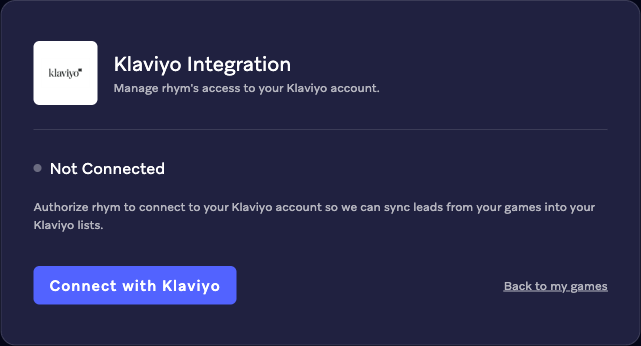
If you're not connected yet, the page shows a **Not Connected** state with a **Connect with Klaviyo** button.
Click **Connect with Klaviyo**. You'll be redirected to Klaviyo's authorize page - sign in to your Klaviyo account and click **Allow** to grant Rhym access to your lists.
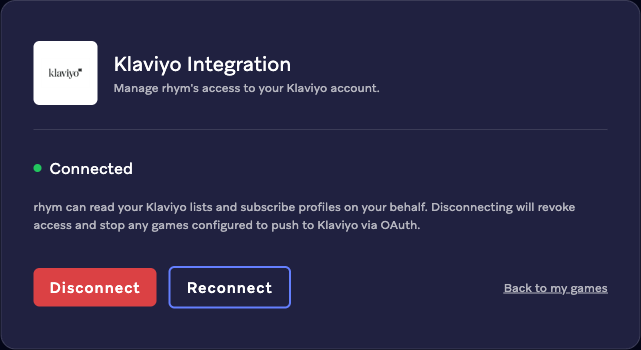
Once you authorize, Klaviyo sends you back to Rhym and the page now shows **Connected**. From here you can also **Reconnect** (rotate tokens) or **Disconnect** at any time.
You only do this once - the connection works across every campaign in your account.
## 3. Add Klaviyo to your campaign
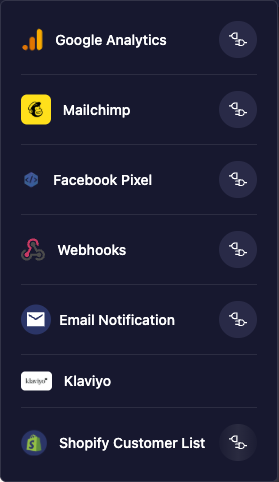
Open the game editor for the campaign you want to wire up. Click **Add Integrations** in the header, then click **Klaviyo**.
## 4. Pick your list and enable consent
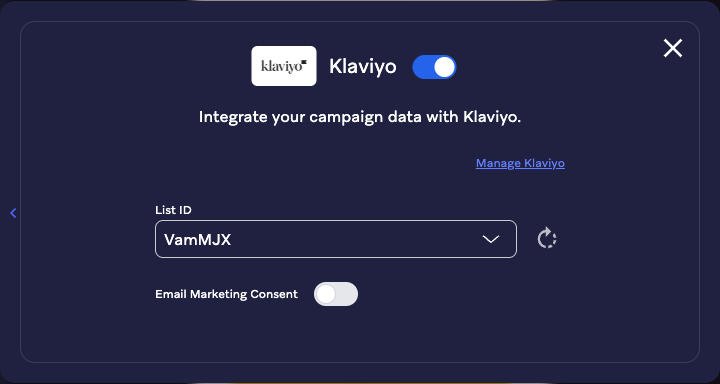
The Klaviyo modal opens. Because you're already OAuth-connected, the modal shows a **searchable List dropdown** populated from your Klaviyo account - start typing to filter by list name or ID. Pick the list you want this campaign's leads to sync into.
A few details:
* **Email Marketing Consent** - if toggled on, profiles are added with marketing consent set to `SUBSCRIBED`. Make sure your Lead Form makes consent clear (a Terms & Conditions checkbox like *"I agree to receive marketing content"*, or an inline notice such as *"By providing your email you agree to receive marketing content"*).
* Toggle the **Klaviyo** switch at the top of the modal to make the integration **Active**.
* Click **Update**. From now on, every lead submitted on this campaign is pushed to your selected Klaviyo list in real time.
## 5. Manage or Disconnect
You can open the same Integration page any time - either from **Account Settings → Integrations → Klaviyo → Manage**, or by clicking **Manage Klaviyo** at the top of the per-game Klaviyo modal.
* **Reconnect** rotates your tokens (useful if you suspect they've been compromised).
* **Disconnect** revokes Rhym's access on Klaviyo's side and clears the connection on this Rhym account. Any campaigns wired to push via OAuth will stop syncing until you reconnect.
## 6. (Alternative) Connect with an API key
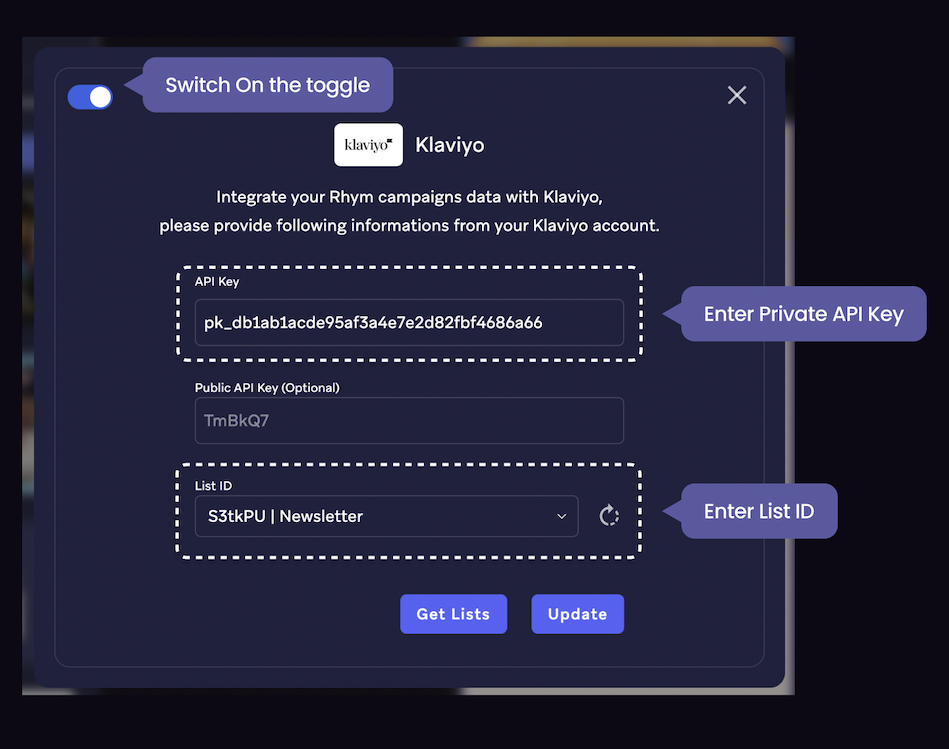
If you'd rather not authorize through Klaviyo, the per-game modal also lets you paste a **Private API Key** and pick a List ID directly. In the Klaviyo modal, click **Connect using API key instead** to switch to the API-key form.
* Generate / locate your Private API Key in Klaviyo - see [How to Manage Your Account's API Keys](https://help.klaviyo.com/hc/en-us/articles/115005062267-How-to-Manage-Your-Account-s-API-Keys).
* Paste the key, click **Get Lists**, pick the list, toggle **Email Marketing Consent** as appropriate, switch Klaviyo to **Active**, and click **Update**.
The API-key path stays available as a fallback - existing campaigns wired this way keep working unchanged.
## 7. How to verify it's working
Publish your campaign (or use the Preview link) and submit a test lead through the Lead Form.
Within a few seconds the profile should appear in the Klaviyo list you picked - with `Email Marketing Consent = SUBSCRIBED` applied if you enabled that toggle. If the lead doesn't show up:
* Confirm the Klaviyo switch at the top of the modal is **Active**.
* Confirm `/integrations/klaviyo` still shows **Connected** (for OAuth) or that your Private API Key is still valid (for the API-key path).
* Make sure your Lead Form actually collects an Email or Phone Number - Klaviyo needs at least one identifier.